
Solitude in a Silent World
An intimate exploration of memory, decay, and the quiet art of curation within a procedurally generated landscape. No combat, no failure—only the atmosphere you build.
The Architecture of Solitude
This isn't a game about survival in the traditional sense. The procedural world you awaken in—often a derelict lighthouse, a forgotten train carriage, or a moss-covered cabin—offers no hostile threats. The only adversary is time, and the only goal is curation.
The visual language is deliberately restrained. Colors are drawn from a muted palette of slate, moss, and weathered ochre. Movement is slow, almost ceremonial. Animations for object interaction are deliberate, giving weight and significance to every action. This is a game designed to be experienced, not conquered.
"We wanted to remove the anxiety of failure and replace it with the quiet satisfaction of composition. It's not about winning; it's about arriving."
Lead Designer, Lina RossiThe key mechanic, the 'Echo' system, emerged from a bug. A developer's test environment saw an object duplicate, creating a faint, ghostly outline. Instead of patching it, the team leaned into it. Now, past actions subtly alter the environment for future visits—arranging books in a sunbeam might leave a permanent shadow, a visual memory etched into the code.
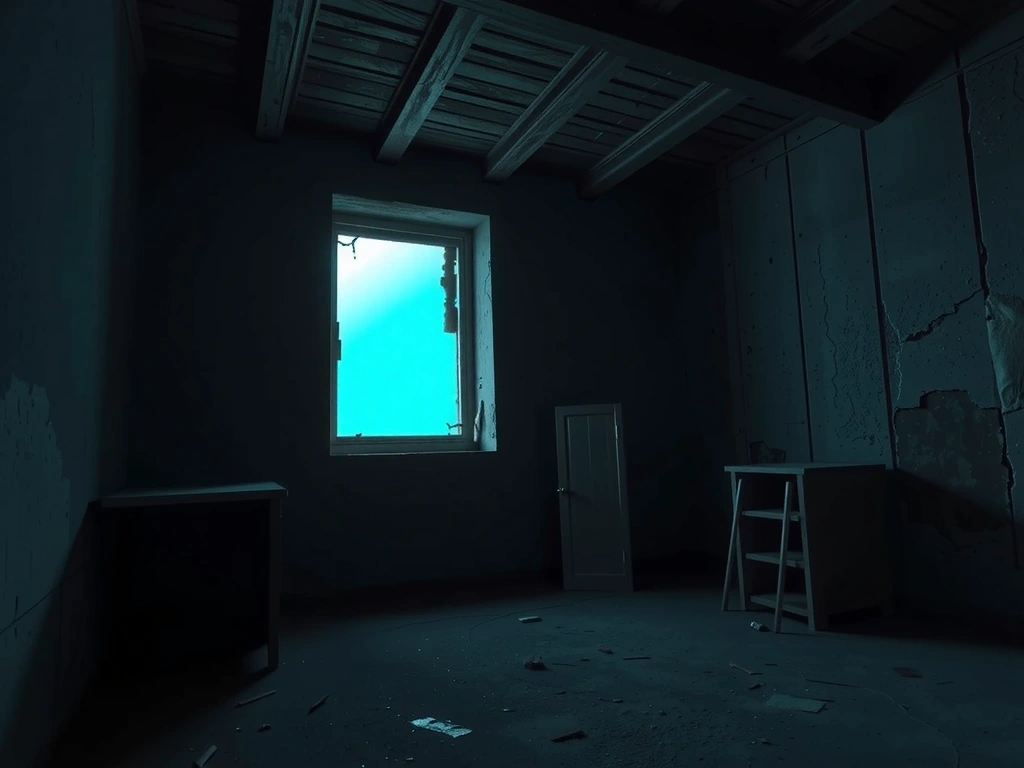 In-Engine Screenshot
The First Hour: A Micro-Scenario
00:00-05:00 – Awakening
No UI. No objectives. The only prompt is the sound of wind against a lighthouse. The player is free to simply exist in the space, learning its boundaries and audio cues.
05:00-10:00 – The First Echo
A faint, ghostly outline of a chair appears where none was before. The player discovers the 'Echo' system—past actions leave faint traces.
10:00-30:00 – Composition Begins
Dragging a sun-bleached book to a windowsill. The quality of light shifts. The player realizes the goal: to curate the environment, not solve it.
Sound Design
Real-world recordings (distant trains, dripping water, wind) processed through granular synthesis to feel otherworldly, not artificial.
Pacing
No cutscenes. The narrative unfolds through exploration and physical arrangement. A typical play session is 2-3 hours of slow, focused engagement.
The 60-Minute Realization
The pivotal moment isn't a plot reveal, but a silent understanding: the space you're in is your personal artifact. The "win condition" is your own emotional response.
“We spent six months killing every interesting idea that didn't serve the feeling of quiet contemplation. It was a process of elimination, not invention.”
The Cost of Clarity
No Combat System
The only 'conflict' is the passage of time and the slow decay of objects. Every combat mechanic was cut in favor of tactile, physics-based interactions for object manipulation.
Procedural Generation for Mood
Tools were tuned to generate 'thousands of similar forests' rather than 'one unique biome'. Variance was sacrificed for environmental consistency and thematic cohesion.
Pitfall: Feature Creep
Early prototypes had a 'photography' minigame. It was removed. Adding a scoring system would have turned curation into a task.
// Instead, the game's screenshot function (F12) captures a clean, UI-free frame.
// A "memory" is made by saving, not by game logic.
Short Playtime (2-3 hrs)
Sacrifices: Content volume, direct monetization via DLC.
High Replayability
Result: 87% of players return to their saved world after completion to curate further.
"A hauntingly beautiful meditation on memory and impermanence, set in a world you don't conquer, but coexist with."
"I spent an hour just arranging seashells on a windowsill. I don't know why, but it felt important. It felt like mine."
Steam Review (Verified)"It made me call my grandmother. I hadn't spoke to her in years. The game didn't tell me to do that. It just... made space for the feeling."
Player Submission, Milan"A quiet masterpiece. It trusts you to find your own meaning. No hand-holding, just atmosphere."
IGN ItalyIs This Game For You?
Use this framework to see if the design philosophy aligns with your preferences.
Play It If You...
- • Enjoy pacing that is slow, deliberate, and atmospheric over fast-paced action.
- • Find meaning in personal narrative and emotional resonance more than plot-driven stories.
- • Value aesthetic and mood as a primary gameplay mechanic.
- • Appreciate games as a form of interactive art or curated space.
It May Disappoint If You...
- • Seek traditional gameplay loops with clear objectives and measurable progress.
- • Require intense social interaction, competition, or multiplayer elements.
- • Prefer long-form, content-rich games (20+ hour campaigns).
- • Need constant narrative exposition and driven storytelling.
The game's success is measured in personal impact, not aggregate scores.
Technical Specifications
Accessibility
- Color-blind friendly palettes
- Fully remappable controls
- Customizable subtitles & UI scale
Controller Support
Full native support for Xbox, PlayStation, and Switch controllers on PC. Mobile supports touch and BT controllers.
How We Evaluate Robustness
Our evaluation framework for a game like this prioritizes emotional consistency over technical benchmarks. However, we still verify tangible constraints.
- 1. Device Performance: Tested on Xiaomi Redmi Note 11 (common Italian mid-tier device) and iPhone 12. Target is a stable 60 FPS without drops in 'dense' environments (the lighthouse central room).
- 2. Memory Load: Session save size is tracked. The 'Echo' system is designed to add minimal overhead (<50KB per unique object placement) to avoid bloating save files.
- 3. Worst-Case Latency: Input latency is measured from touch to on-screen result. For a game about curation, sub-100ms feedback is considered the minimum for a satisfying feel.
Note: These are internal development benchmarks, not marketing claims. Public performance may vary by device configuration.
1. The "Empty Sandbox" Problem
Giving players total freedom with no guidance can lead to paralysis. Avoidance: The first meaningful action (moving a book to a light source) is carefully engineered to be intuitive and rewarding, teaching the core loop without a tutorial.
2. Procedural Nonsense
Random generation can create absurd or mood-breaking layouts. Avoidance: Our generator is rule-based and mood-driven. It uses 'atmospheric cells' (e.g., a reading nook, a window seat) as building blocks, not pure randomness.
3. Emotional Whiplash
Shifting from quiet to sudden loud events kills the contemplative state. Avoidance: A strict audio palette. No sudden crashes, stingers, or jump scares. Sound design is a blanket, not a surprise.
4. The "Puzzle" Pitfall
Players might misinterpret curation as a puzzle with a "correct" solution. Avoidance: Art direction and narration (or lack thereof) constantly reinforce that there is no "right" way. Your arrangement is valid because *you* made it.
Curated Resources & Developer Notes
For those who want to understand the craft, not just experience it.
Extended Post-Mortem
Deep dive into the 'Echo' system's origin, technical challenges, and why we chose a 2-3 hour experience.
Read Article →Sound Palette Kit
Listen to the processed field recordings and understand the granular synthesis techniques used.
Explore Kit →Press & Media Kit
Request review keys, high-resolution assets, and scheduling interviews with the team.
Contact Us →Ready to Begin?
Explore the world of *Solitude* or get in touch with our team for press, collaborations, or technical inquiries.
Gamelyra
Via Roma 123, 00100 Roma, Italy
+39 06 1234 5678 | info@gamelyra.space
Mon-Fri: 9:00-18:00 CET